|
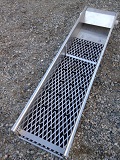
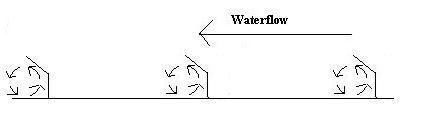
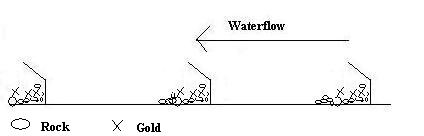
To most of us a sluice box is simply a long trough with catch riffles placed along its length. A flow of water is fed into a raised upper section and gold bearing materials such as sand, gravel, black sand and gold are wash throughout the length of the sluice. The way a sluice box works is to wash away all, or at least most, non-gold related materials with water. What makes gold “stick” is usually raised “riffles” that will trap the heavier gold behind while flushing 99% of all Sands and gravels out the low discharge end of the box. The riffles form small low pressure zones immediately behind them allowing heavier particles to settle out on the “lee side” of the riffles. If you take a close look right behind any one of these riffles you will see particles “dancing” is the water flows over them. This constant movement is heavier pieces being held in place in a “suspended medium”, meaning if it weren’t for the weight of the particles, they would be swept away by the current moving through the sluice box. The reason for the constant particle movement is the water right behind the riffle is trying to lift and move the suspended or trapped pieces by a low-pressure turbulent current. In any case, this represents how most early sluice boxes work.
Later developments led to type of riffle called a “Hungarian riffle” or “Hungarian riffles”. Another name for this riffle style is a “Lazy L”. The main advantage of the Hungarian riffle is its increased low-pressure zone behind each riffle bar. A disadvantage is that
the water flow and sluice box angle are much more critical with this system. As long as you are willing to “tune your sluice” you will get good production with the “Lazy L” riffle type.
However, given time and a lot of experimenting much more effective gold recovery techniques have been developed. No, I wouldn’t call these techniques high tack but more along the lines of good common sense. You know when you start to recognize the same pieces of gravel in your sluice test tank that you have already spent too much time refining and finishing your design.
Over the last hundred years littlest changed in general sluice box design. Some people have done basic changes like the Hungarian riffle and others have come up with a dredge powered three stage sluice that floats on the River or stream surface that no one is done a good job of making more efficient sluice. I’m not a big fan of “conventional three stage sluices” as they do a terrible job of attempting to recover fines. In fact, I can honestly say from first-hand experience you will lose 90% of all fine/flour gold right out of the waste chute. In order for one of these dredges to work and not jam up you have to really pour the water flow to it and often the pressures are excessive. In fact, do me a favor, next time he floating three stage sluice box is cleaned up, take a look at the size of gold particles. There will be a little like gold but the rest is only larger heavier material.
Depending on the area you are in you will be thrown away a greater portion of your almost recovered gold. Simply adjusting water flow on your sluice box angle what work because you either cause a jam or shoot everything straight through. This of course is what got me working on a new approach to sluice box design.
Submerged classifiers offer a 99.9% fine material separation and then you can handle the gold separation process from there. The hardest part is establishing the right graded material to the right water flow after that gold separation is easy, duck soup actually.
I also wanted cleanup to be painless and quick versus rinsing blankets or a mass material which can take a while to properly. I guess I looked at it like I spent the past 6 to 8 hours shoveling or dredging and now I want to see my gold. I don’t want to play with blankets rather time-consuming capture materials I just want to dump the gold into a jar or gold pan and see what I have.
We still use gravity separation to capture fine, flour and flake gold it’s just that with different levels of classified material we can do a great job of flow control to recover some of the finest particles of gold. Blankets and capture Moss does work to an extent to trap flake gold more by default than by design. While setting up my gold capture systems I played a lot with water current just to see how little flow it took to move waste materials through and still recover small gold particles. With super tiny gold it doesn’t take much to trap it out. The trick is a fully functional classifier that won’t jam up and allow fast throughput of all materials. I come up with two built-in classifiers. A few progressive miners are already working with one system and the other is a much faster method of extracting gold based on a similar approach. Both methods are not cheap but you can pay for a greatly improved system and his little as three days of mining an already worked area, the effort was worth it.
I’m also over halfway through designing an add-on system that you can attach to almost any existing sluice set up and capture 90% of all missed fine a small flake gold. This miss gold is common with bigger high production rigs the process hundreds of yards of material per run. Now you can have a bonus after regular cleanup of super fine gold from this add-on system. The add-on does not restrict regular throughput at all as you could lay a straight edge from existing sluice to the set up and it would be the same height or ever so slightly lower.
All we do a separate the 1/8 inch minus material and then the micro fine gold from that. All of the rest the material is sent to through. Even a badly designed sluice box will catch larger gold Nuggets with this add-on. It’s this extremely plentiful flour and fine gold the requires a finer approach to recovery and that’s why I spent so much time working on the fine gold section.
• Greater classified material you’re processing.
• Use the right capture media.
• Set the correct angle and water flow on your sluice box.
• Collect the find when you’re finished processing gold bearing sands and gravels.
All of this is done automatically for you. All you have to do is take a few moments cleaning up the fine gold section when you are done your run a materials. Simple and fast... And profitable! Please remember this is called few other people can catch with a standard sluicing system. Working area full of fine micro flake gold? Try my “Fine Gold River Master” sluice system. Every part of it is built around recovering this plentiful flour gold.
|